Shower Door Replacement: How to Replace an Old Shower Door Yourself
Here is how to replace a shower door in four steps: take out the old door, measure the opening, choose a door that fits, and install it. Two people can do the whole shower door replacement with ordinary tools, whether the old one is a framed tub door or a frameless glass shower door. At the smallest standard size, MCOCOD replacement doors start at $619 for a framed double slider and $719 for a frameless single slider, with free shipping to the contiguous U.S.
A replacement usually starts with one of a few problems: the glass is chipped, the frame or track has corroded, the parts are no longer made, or the old framed door just looks dated. If your door only leaks, sticks or rattles, a new seal or a set of rollers may fix it for a fraction of the price. Replace or repair a shower door walks through that decision. This guide is for the case where the whole door has to go.
Before you start: what you need
For the removal you need a utility knife or razor scraper, a screwdriver or drill, gloves, safety glasses, painter's tape and a helper to hold the glass. For the new door, the MCOCOD DS13 manual lists a spirit level, tape measure, power drill and bits, screwdriver, silicone gun, pencil, hacksaw and rubber hammer. Have a clear, flat spot outside the bathroom ready for the old glass and the new panels, with a towel or cardboard underneath. Our shower door installation guides cover planning for each door type if you want more depth on any step.
Step 1: Remove the old shower door
Tempered glass is strong across its face and weak at its edges. A knock on a corner can shatter the whole panel, so keep the edges off tile and hard floors the whole time.
- Cut the caulk. Run a utility knife along every silicone line where the frame or track meets the wall and the tub or base.
- Take the glass out first. On a sliding door, lift each panel up and tilt the bottom out to free the rollers from the track. On a hinged door, have your helper hold the door while you unscrew the hinges.
- Unscrew the frame. Remove the wall jambs, the header and the bottom track. Old tracks are often glued down with silicone, so work a putty knife under them rather than prying from one end.
- Clean the surfaces. Scrape off the old silicone, then wipe the tile with rubbing alcohol so the new sealant will stick.
With the old door out, look at what was hidden behind it: loose or cracked tile, soft grout, or water stains on the wall. Fix those before the new door goes in. How to remove a shower door safely covers the removal in more detail.
Step 2: Measure the opening
Measure after the old door is out, from the finished tile or acrylic surface, never from the framing or from the old door's size. Write down:
- Width at the bottom, along the top of the tub or threshold.
- Width at the top, at 72 inches high for a shower door or 60 inches high for a tub door.
- Height, from the top of the threshold or tub edge to the top of the tile or surround wall.
- Threshold depth, front to back.
- Whether the walls are plumb and the threshold is level. Hold a level against each wall and along the threshold and note how far each one is off.
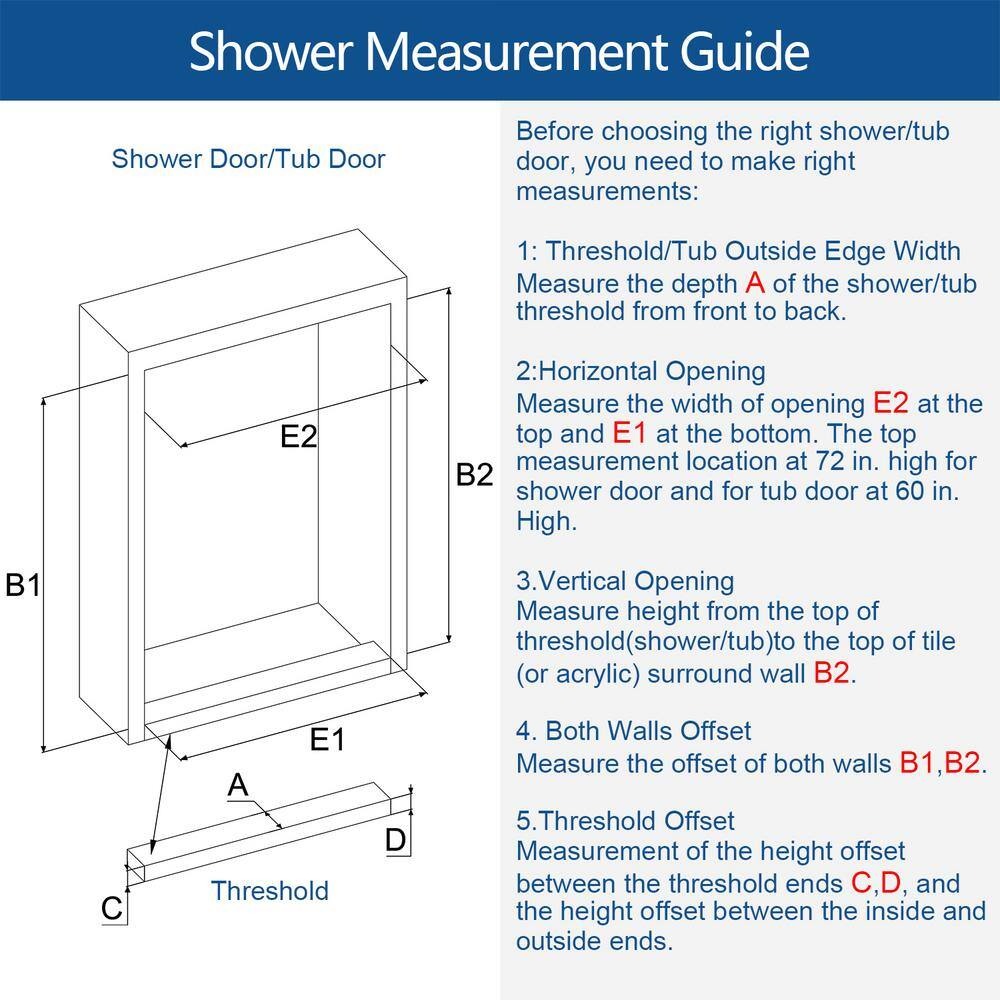
Your two width readings will almost always differ a little. Use the smaller one when you choose a size. If the top and bottom widths differ by a lot, or a wall is clearly out of plumb, send us the numbers before you order. The full method, with diagrams, is in our shower door measuring guide.
Step 3: Choose the replacement shower door
Start from the opening, then pick the style. These are the standard sizes of MCOCOD replacement shower doors, in inches:
| Door | Type | Glass | Widths | Heights | From |
|---|---|---|---|---|---|
| DS13 | Double sliding, frameless, soft-close | 3/8" | 48, 54, 60, 66, 72, 76 | 60 to 79 | $1,129 |
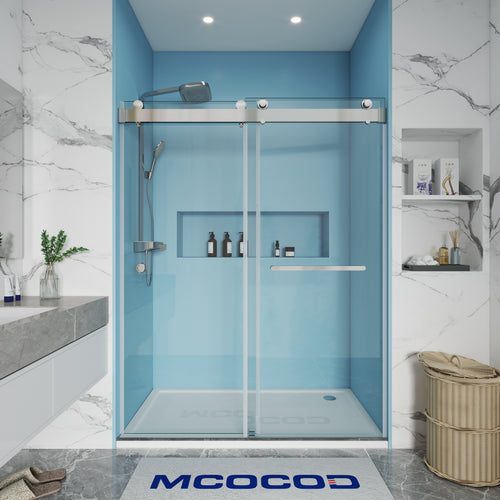
| DS01 | Double sliding, frameless | 3/8" | 48, 54, 60, 66, 72 | 60 to 79 | $1,029 |
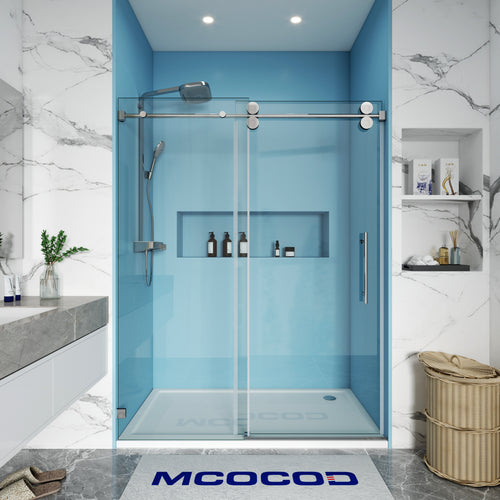
| SS08 | Single sliding, frameless, soft-close | 3/8" | 48, 54, 60, 66, 72, 76 | 60 to 79 | $1,049 |
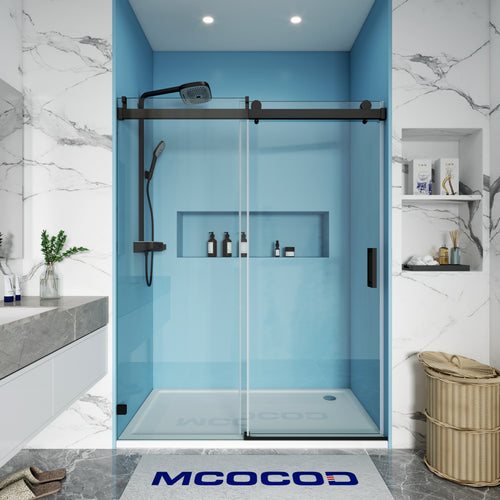
| SS14 | Single sliding, frameless, soft-close | 5/16" | 48, 60 | 60 to 76 | $719 |
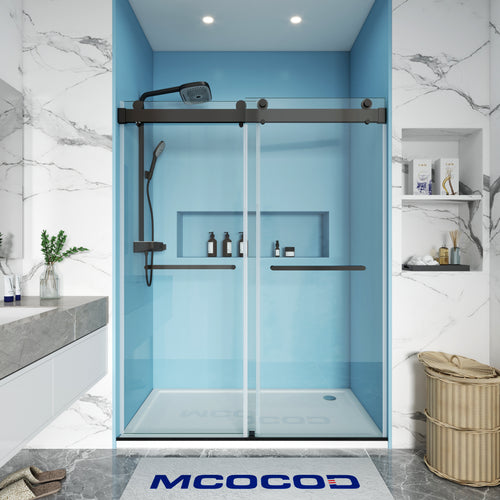
| DS06S | Double sliding, framed | 1/4" | 48, 60 | 60 to 76 | $619 |
Not every width comes in every height: the 60-inch width has the most height options, and the other widths mostly come at 76 inches tall. Larger sizes cost more than the starting price, and each product page lists the exact sizes and prices. If your measured width falls between two sizes, send us your measurements before you order.
A few rules of thumb help narrow it down:
- Replacing a tub door. Most alcove tubs are 60 inches wide, so look at the 60-inch sizes and pick the height by how high your tile goes. All the doors above come in 60 × 60. See all bathtub sliding doors.
- Single or double sliding. A single slider has one moving panel and one fixed panel, so you always enter from the same side. A double slider opens from either side. Single vs. double sliding shower doors compares them.
- Swapping framed for frameless. Frameless doors use thicker glass and a top rail instead of a full frame, so check that the walls can take the brackets where the rail mounts.
- When no standard size fits. If the opening is narrower than 48 inches, wider than 76, badly out of plumb, or a corner or angled layout, a custom shower door is made to your measurements.
Step 4: Install the new door
Every model installs a little differently, so follow the manual that comes with your door. You can download it ahead of time from our instruction manuals page. On a frameless double sliding door like the DS13, the order is:
- Mark and fix the wall brackets with a level.
- Measure the opening width (L) and cut the guide rail to L minus 1 inch, then mount it on the brackets.
- Fit the rollers to the first panel, hang it on the rail and level it.
- Screw down the bottom guide block at the middle of the opening.
- Fit the seals and hang the second panel.
- Fit the anti-jump knobs and the towel bars.
- Cut the threshold strip to width, set it in silicone, and keep the shower dry for 24 hours.
If the door goes over tile, the manual asks for the tile to run completely under the wall jamb. Inside the shower, no sealant is needed unless your manual says otherwise.
This video shows a full DS13 installation:
Our sliding shower door installation guide goes through each step and the common mistakes.
After the new door is in
Keep the manual and the product code. You will need them if you ever order replacement rollers, seals or other shower door hardware. Day to day, squeegee the glass after each shower and wipe the glass and metal now and then with mild soap and water. Scouring pads and sharp tools scratch both. For hard water marks and soap scum, see how to clean glass shower doors.
What a shower door replacement costs
If you do it yourself, the cost is mostly the door. At the smallest standard size, a framed slider starts at $619, the SS14 single slider at $719, and the 3/8-inch frameless doors at $1,029 to $1,129, before finish and size upgrades. Add silicone and drill bits. Shipping is free to the contiguous U.S.
If you would rather not install it yourself, MCOCOD offers professional installation for $600 in a number of metro areas, among them Los Angeles, Phoenix, Seattle, Dallas, Houston, Chicago, Atlanta, New York and Boston. You choose it on the product page, which lists the areas covered for that door. The product page says the $600 includes installation and warranty, and that removing the old door costs extra. For a wider look at what goes into a quote, see shower door replacement cost factors.
Frequently asked questions
Can I replace just the glass in my shower door?
Sometimes, if the frame is in good shape and you can get glass cut to the same size and thickness. On an older door it is often cheaper and faster to replace the whole door. Can you replace just the glass? explains when it works.
Can I put a new door on my old track?
Usually not. Tracks and rollers are made for one door series, and a new door comes with its own rail, brackets and guides. Take the old track out completely.
Do I need to re-tile after removing the old door?
Not if the tile behind the old frame is sound. Clean off the old sealant and replace any cracked tiles before installing, because the new brackets need a solid wall.
How many people does it take?
Two. The manual calls for two people, mainly to lift and hang the glass panels. After the threshold is sealed, keep the shower dry for 24 hours.
Is a frameless door harder to install than a framed one?
The steps are similar. The difference is weight: 3/8-inch frameless panels are heavier than the 1/4-inch glass in a framed door, so the second person matters more, and the wall brackets need solid backing.
Every MCOCOD shower door comes with a 10-year warranty. If you are not sure which door fits your opening, send us your measurements and a photo and we will help you choose. You can also browse all shower doors.