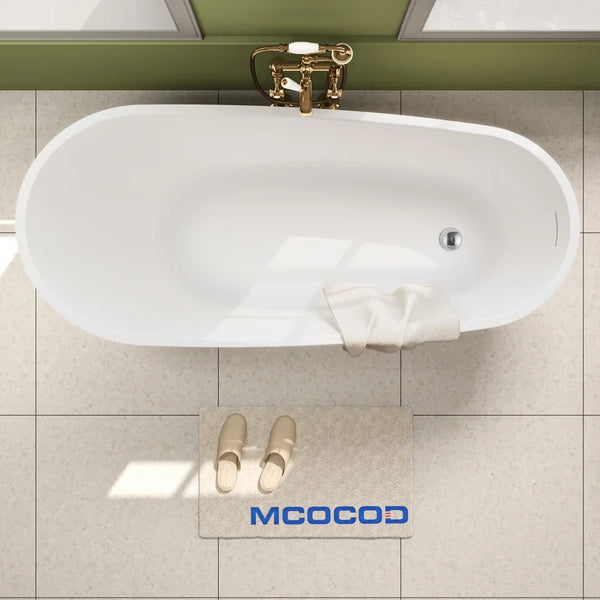

Stone resin sits between acrylic and cast materials: heavier and warmer than acrylic, lighter and more repairable than cast iron, and considerably more sensitive to how it is supported and cleaned. The material decides the installation method, and the installation method decides whether the shell stays quiet and flat over ten years.
What Stone Resin Is and What It Is Not
Stone resin is a composite - a mineral filler bound in a resin matrix, moulded into the shell shape and usually finished with a gel coat or a polished surface. It is not stone and it is not a single material: the ratio of mineral to resin, the wall thickness and the reinforcing layer vary between products, and those variables decide weight, stiffness and repairability.
It is also not automatically a solid surface. Solid surface material can be sanded and re-polished across its whole thickness, while a stone resin shell with a gelcoat finish is repaired at the surface. Ask which of the two the tub is before assuming a scratch can be polished out.
| Property | What it changes | What to ask for |
|---|---|---|
| Mineral to resin ratio | Weight, stiffness, warmth | Material data rather than a marketing term |
| Wall thickness | Rigidity and resistance to flexing | Nominal thickness |
| Reinforcing | Behaviour underfoot across the base | Base build-up detail |
| Finish type | Whether scratches can be polished out | Gelcoat or solid surface |

Weight, Wall Thickness and Reinforcing
A stone resin shell is heavier than an acrylic shell of the same size, which changes two things: the floor load and the delivery route. The filled weight still dominates, so the structural question is the same as for any tub, but the dry weight matters because it decides how many people the delivery needs and whether the shell can be carried up a stair turn.
Wall thickness and reinforcing decide stiffness. A thick shell with a hollow base can still flex underfoot, while a thinner shell bonded to a proper support layer does not. Ask how the base is built rather than how thick the wall is, and set the shell on the support the manufacturer specifies rather than on packing pieces.

Cleaning and Repair Boundaries
The surface is non-porous and tolerant of ordinary bathroom cleaning, but abrasive powders and scouring pads cut through a gelcoat and leave a dull patch that stands out under side lighting. Cleaning products with a recognised environmental and material profile are listed by the EPA Safer Choice programme and make a reasonable filter for what to use.
Repair follows the finish type. A solid surface shell can be sanded and polished back to a uniform face. A gelcoat shell can be repaired with a matching filler and blend, but the repair is local and may show under grazing light. Where the damage is a crack rather than a scratch, the shell should come out rather than be patched in place.
Heat Retention and Warmth to the Touch
Composite shells feel warmer to the touch than cast or porcelain and lose heat more slowly than a thin acrylic shell, because the mineral content adds mass and the wall resists heat flow. That is the main practical reason to choose the material: an unheated bathroom where a long soak would otherwise cool quickly.
The water surface remains the largest source of heat loss regardless of the shell, so a deep tub with a small exposed surface holds temperature better than a shallow one with a wide surface. Where the household wants a long, hot soak, shell material and tub geometry should be considered together. Water heating guidance is published by the US Department of Energy.
Delivery, Access and Floor Loading
Weight is felt first on the way in. Measure the narrowest door, the tightest stair turn and the ceiling height on the route before ordering, and check whether the shell can be carried on its side without loading the rim. A heavy shell that will not pass the route becomes a crane or a window lift, which is a cost that appears after the purchase.
Inside the room, the filled load is carried by the floor rather than shared with a surround, so confirm the joist direction and spacing under the footprint. The assembly context for the floor and the wet room is described on the Whole Building Design Guide.
Stone Resin Against Acrylic and Solid Surface
Acrylic is lightest and cheapest to install, but needs insulation to hold heat and is the hardest to repair invisibly. Stone resin is heavier, holds heat better and can be finished either as a repairable surface or a gelcoat. Solid surface is the most repairable of the three and usually the heaviest at the same thickness.
| Property | Acrylic | Stone resin | Solid surface |
|---|---|---|---|
| Dry weight | Lowest | Moderate | Highest |
| Heat retention | Needs insulation | Good | Good |
| Repairability | Limited | Depends on finish | Sand and polish |
| Delivery access | Easiest | Needs checking | Needs checking early |
The comparison across shower formats, which uses the same logic, is covered in the guide to acrylic versus fiberglass.
Ordering Checks
Confirm the finish type, the base build-up, the inside dimensions and depth to the overflow, the drain and overflow set, and the delivery route. Then confirm the floor structure. Six items, all answerable before the order goes in, and all of them expensive to correct afterwards.
Component test methods for tubs and drain fittings are published by ASTM International, and plumbing requirements come from the adopted code published at iccsafe.org. Where an existing tub has leaked, the moisture guidance published by the EPA explains how far the repair should extend first.
FAQ
Are stone resin bathtubs good?
They are a good choice where a warmer, quieter, more substantial shell matters and the floor and delivery route can take the extra weight. Judge a specific tub on mineral content, wall thickness, base build-up and finish type rather than on the material name, since the same name covers a wide range of construction.
Which bath is better, acrylic or stone resin?
Acrylic is lighter, cheaper to install and easier to carry into a tight bathroom, but needs insulation to hold heat and is difficult to repair invisibly. Stone resin is heavier and holds heat better. The deciding factors are floor loading, delivery access and how long the household soaks rather than the material alone.
How do I clean a stone resin bathtub?
Use a non-abrasive cream cleaner or a mild liquid detergent with a soft cloth, rinse well, and avoid scouring powders, pads and solvents that attack the finish. Products with a recognised environmental and material profile are listed by the EPA Safer Choice programme. Rinse after cleaning so residue does not dry on the surface.
How long do stone resin tubs last?
Service life depends on the base build-up, the finish type and how the shell is treated rather than on a fixed number of years. A shell set on the specified support with an undamaged finish lasts well; one that flexes underfoot or has been scoured through its gelcoat degrades at the surface first.
Send the bathroom dimensions, the delivery route and the water heater capacity, and we will confirm the shell size and support method that suit the floor and the soak.