


Shower Door Handle Replacement: Identifying, Fitting and Replacing Them
A handle is the only part of a shower door that every user touches, and the easiest component to change. It is also the part most often ordered wrongly, because the fixing holes are already in tempered glass and cannot be moved: the replacement has to match a pattern rather than be made to fit one.
What Defines a Handle
Four attributes decide compatibility. The fixing hole spacing - centre to centre - decides whether the handle lines up at all. The glass thickness decides the barrel or bolt length that joins the two halves. The hole diameter decides whether the supplied gaskets seat properly. And the mounting type decides what the handle looks like from each side: through-glass with a fixing on both faces, or surface-mounted on one.
Beyond compatibility, the choice is about leverage and grip. A bar or long pull gives a hand something to wrap around, which matters on a heavy 3/8 in. frameless panel. A knob concentrates force into a small circle, which is comfortable on a lighter door. A towel bar does both jobs, at the cost of a larger footprint.

Measuring Before Ordering
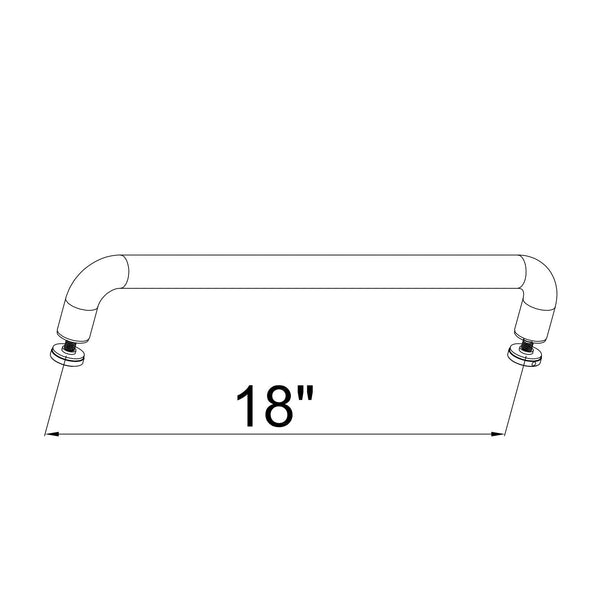
Support the door, then measure with the handle still in place: the centre-to-centre distance between the two fixing holes, the glass thickness at the hole, and the hole diameter with the fixing removed. Photograph the handle and the hole with a ruler in the same frame - that single image usually resolves any ambiguity about barrel length or gasket type.
| Measurement | Where to take it | What it decides |
|---|---|---|
| Hole centres | Centre to centre of the fixing holes | Whether the handle fits the existing drilling |
| Glass thickness | Calipers on the panel edge | Barrel or bolt length between the halves |
| Hole diameter | Across the hole, fixing removed | Whether gaskets and washers seat |
| Clearance | Distance to the wall or fixed panel | Projection that will not foul when the door swings |
Choosing the Grip for the Door You Have
On a heavy panel, a longer grip earns its space: the wider and taller the door, the more force is needed at the edge to start it moving, and the more a small knob becomes a pinch grip. On a narrow door or a bifold leaf, a compact handle reduces the chance of catching clothing, and on a sliding door a single-sided pull keeps the inside face flush when the panels pass.
Two further details matter in use. Handle height changes little where the holes are already drilled, but where a panel is being made to order, between about 36 in. and 42 in. from the finished floor suits most adults. And the projection of the handle has to clear the wall, the fixed panel and any towel bar throughout the door's travel.

The Swap Itself
Support the door, remove one side of the fixing while holding the other, and push the barrel through. Fit the replacement with fresh gaskets or washers where supplied, and tighten evenly - alternating between the two halves - until the gasket is compressed and no further. Over-tightening is the usual cause of a star crack appearing at the hole days later.
Two rules prevent damage. Never enlarge an existing hole, and never drill a new one: tempered glass is cut and drilled before it is toughened, and any attempt to machine it afterwards releases the panel. Glazing used in these positions is architectural glazing under 16 CFR Part 1201, and fabrication guidance is published by the National Glass Association.
When the Handle Is Not the Problem
A handle that has come loose is sometimes a symptom rather than a fault. If the door has dropped, the handle may be contacting the wall or the fixed panel and taking load it was never designed to take, which works the fixing loose. Adjust the hinges or rollers first, then re-check the handle. Where the door sits in a wet area, the methods behind the surrounding tiling are published by the Tile Council of North America and catalogued on the Whole Building Design Guide.
Similarly, a handle that needs replacing every couple of years usually points at the environment rather than the part: constant moisture and aggressive cleaning attack the finish, and the fixings corrode. Moving to a stainless or soundly coated component, and switching to a non-abrasive cleaning routine, extends the life of the next one.
Finishes and Matching the Enclosure
Handles are available in the standard wet-room finishes: Matte Black, Chrome, Brushed Nickel and Brushed Gold. Match the handle to the hinges and clamps on the same panel, and carry the same finish across any towel bars or rails. In a wet room, Matte Black shows edge corrosion and mineral bloom earliest; Chrome and Brushed Nickel are the most forgiving; Brushed Gold sits between them.
Where a finish claim matters, ask which standard it was tested against. Hardware durability ratings and the test methods behind them are described by the Builders Hardware Manufacturers Association and published by ASTM International.
Buying the Right One First Time
Three facts make an order reliable: hole centres, glass thickness and finish. Add the mounting type - through-glass or single-sided - and, for a sliding door, confirm that the handle does not foul the other panel as it passes. Where the door series is known, a matched handle for that series removes the measurement risk entirely.
Where the handle is part of a wider repair - a door that also needs seals or rollers - order together. The door comes apart once, and parts that have worn in the same wet environment tend to fail within the same period. Replacement components for each series are listed in the hardware collection, and a site FAQ covers the common ordering questions.
For the related decision path and supporting articles, use Shower Door Repair and Replacement Parts.
FAQ
Can you replace handles on shower doors?
Yes, and it is the simplest upgrade on a door. Measure the fixing hole centres, the glass thickness and the hole diameter, then order a handle with the matching barrel and gaskets. Support the door while swapping, and tighten only until the gasket is compressed.
Are all shower door handles the same size?
No. They differ in hole spacing, the glass thickness they are cut for, the barrel length and the projection from the glass. Two handles that look similar can be incompatible, so the measurements taken on your own door decide rather than the catalogue photo.
Are replacement door handles universal?
Only where the fixing pattern matches. Through-glass handles are made for a specific hole spacing and panel thickness, and because tempered glass cannot be re-drilled, a universal handle that does not match the existing holes cannot be adapted - the panel would have to be replaced.
What are shower door handles called?
In catalogues they appear as back-to-back handles, pulls, knobs, single-sided pulls, and towel bars. The naming describes the mounting and the grip rather than the function, and all of them are specified by the fixing hole centres and the panel thickness.
Send the hole centres, glass thickness and the finish you want, and we will confirm the handle that fits your existing holes without touching the glass.
Browse shower door handles · See hinges, clamps and rails · Request a handle match